
Environmental Control in Quantum Operations
Praecis designs, builds, and supports the environmental controls that quantum computing development, manufacturing, and operation require. Each system, delivered as a Praecis Environment, is built around a Praecis Air Temperature Control Unit (ATCU), which controls and integrates every other environmental function.
Requirements
Quantum computers are built on several hardware platforms, and each is sensitive to its environment in different ways. Most run part of the system cryogenically, but much of it does not: lasers, room-temperature optics, fiber and cable interconnects, control electronics, and the space around each cryostat or vacuum chamber. Outside the cold stage, thermal drift, vibration, acoustic noise, stray electric and magnetic fields, and contamination all erode qubit fidelity and system performance, while the lasers themselves present hazards that must be contained.
Photonic systems. Photons carry the computation, routed through photonic chips in cryogenically cooled cabinets that are linked to form the full machine. Thermal drift in room-temperature optics and fiber, and vibration at optical interfaces, degrade photon fidelity.
Trapped-ion and neutral-atom systems. Qubits are held in ultra-high-vacuum chambers and controlled by lasers. Laser frequency and beam-pointing stability, magnetic field stability, and vibration of the optical table set gate fidelity, and the laser systems typically require Class 1 containment.
Superconducting systems. Qubits operate inside dilution refrigerators at millikelvin temperatures. The refrigerator’s pulse-tube cooler is a major vibration source, RF and magnetic interference must be excluded, and the room-temperature control electronics need a thermally stable environment to keep signal timing and amplitude steady.
Three further points shape our approach, whatever the platform:
The cryogenic plant is itself a major source of vibration and acoustic noise, therefore Praecis designs the isolation with the plant running.
Cold interfaces create condensation risk, so Praecis specifically designs the humidity control around them.
The environmental disciplines conflict with one another. Every vent, door, window, and penetration is a potential leak path for heat, moisture, particles, sound, light, and RF, therefore Praecis engineers design the system as one integrated whole.
Technical Capabilities
Temperature control. The Praecis ATCU is the core of every system. It holds thermal stability to ±0.005°C, delivers conditioned air through engineered paths that minimize gradients and turbulence, and coordinates the other environmental functions.
Humidity and cleanliness control. Relative humidity is held at a specified setpoint, typically 40–45% RH, within ±3% RH (±1% RH available), with dew point kept below the coldest exposed surface to prevent condensation at cold interfaces. HEPA or ULPA filtration with positive internal pressure maintains ISO 14644-1 Class 5 or better (to Class 1 where required) inside the enclosure, and materials are selected for low outgassing and low particle shedding.
Acoustic and vibration isolation. Multi-layer acoustic construction blocks external noise, holding internal levels at NC-30 or below, and equipment mounting and airflow paths keep internally generated noise away from sensitive components. Passive and active vibration isolation is integrated where required to meet VC-E (3 μm/s) or better at the payload, including isolation from cryocooler-generated vibration.
Laser protection. Enclosures are configured as Class 1 laser enclosures where required, with light-tight construction, interlocked doors and access panels, and laser-safe viewing windows rated for the system’s wavelengths, supporting compliance with ANSI Z136 and IEC 60825.
RF, static, and magnetic shielding. A continuous, gasketed conductive shell blocks RF interference, with shielding effectiveness of 80 dB or greater from 10 kHz to 10 GHz, designed to IEEE 299. Grounded, static-dissipative construction (surface resistance 106–109 ohms, per ANSI/ESD S20.20) controls static electric fields. Static and low-frequency magnetic fields are held to below 100 nT residual variation with passive high-permeability shielding, active field cancellation, or both, designed together so they do not interfere.
Fiber and cable feedthroughs. Fiber, electrical, signal, and fluid lines enter through feedthrough panels configured to the system’s connection count. Waveguide ports and filtered connectors preserve RF shielding, and every penetration is sealed, light-tight, and acoustically treated so it maintains all other protections.
Integrated engineering. Praecis models and designs each Praecis Environment as one system, covering thermal and airflow, structural and vibration, shielding, and acoustics, and resolves the trade-offs between disciplines before fabrication. Final performance values for each project are set in the signed-off environmental specification. See Praecis Environment Systems for the full range of controls.
Measured Performance
Measured performance of a Praecis ATCU over 28 hours. Room temperature swung 1.19°C, while the critical point inside the enclosure held within 0.005°C.
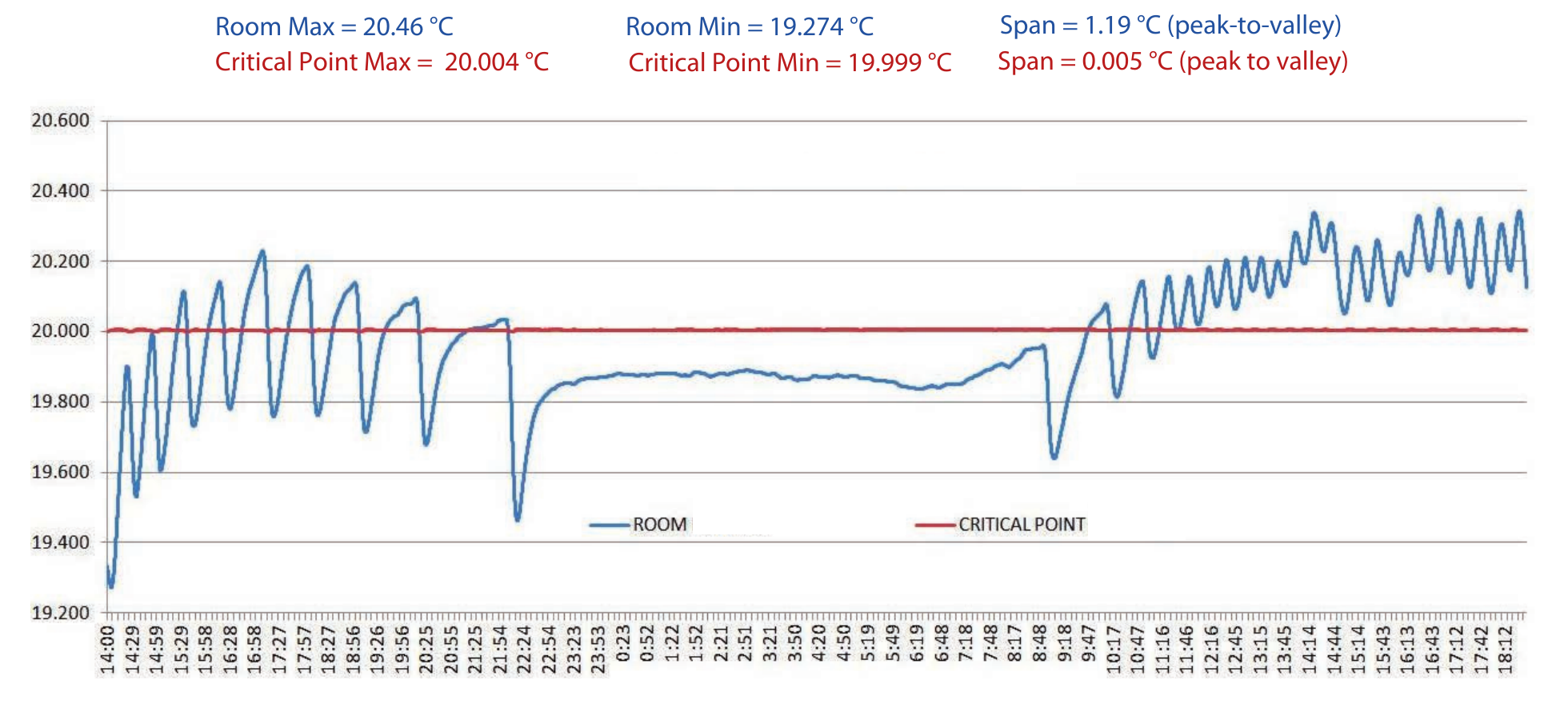
Ambient room temperature (blue) vs. critical-point temperature inside the enclosure (red) over 28 hours. The room varied 1.19°C peak-to-valley and the critical point 0.005°C peak-to-valley, a ratio of more than 200:1. Over a 10-hour stretch without abrupt ambient disturbances, the critical point held within 0.002°C peak-to-valley.
Contact
To discuss the environment your system needs, request a quote or contact Susan Thompson at www@praecis.com.The Requirements
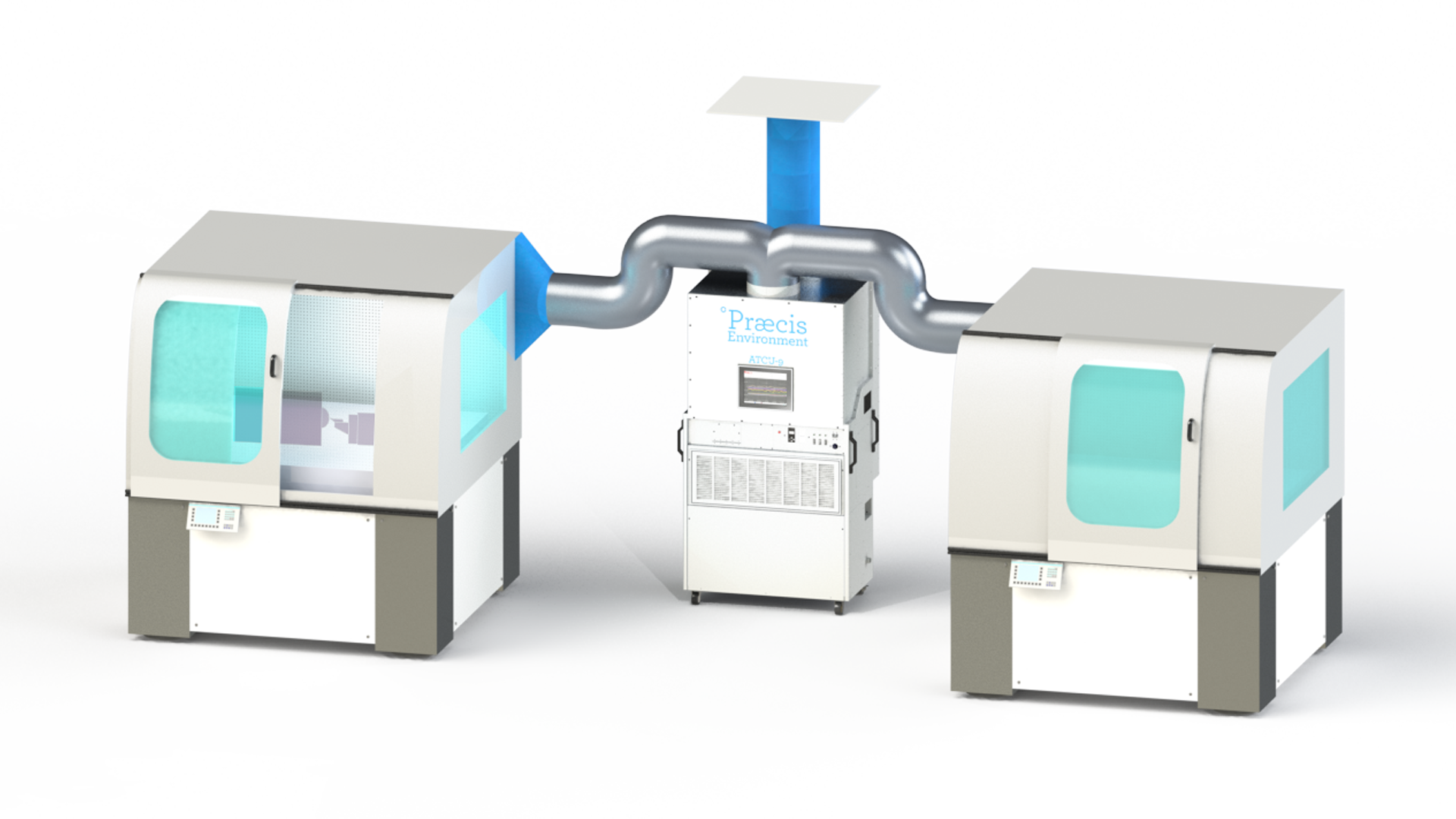
Dual Optics System

Small Optics Environment

Large Optics System