
Stable conditions for nanometer manufacturing
Mask writers, metrology systems, bonding tools and development labs run for hours or days, and the air around them moves the substrate, the stage, the metrology frame and the interferometer beam path.
Praecis designs, builds, installs and tunes environmental enclosures around the semiconductor tools and processes where nanometers are lost to air. Each Praecis Environment is built around a Praecis Air Temperature Control Unit (ATCU), which holds the critical point to ±0.005 °C and commands every other environmental function in the enclosure.
Where Praecis fits
Thermal control in a fab happens at three levels, and Praecis works at the one in between.
- The fab. Cleanroom air handling holds the building to tenths of a degree. It is designed for whole bays, not for the air at one tool.
- The tool. Scanners and other major tools control their own internals: wafer stages, projection optics, reticle cooling and bake plates. Tool makers engineer these, and Praecis does not replace them.
- The local environment. This is the air at a tool's intake and around its critical point, and the space around metrology systems, bonding tools, mask writers and development benches. Fab air is too coarse for it and the tool maker does not control it. Praecis builds this environment to ±0.005 °C.
When the local environment drifts, the tool spends its own control budget fighting the room, and the residual error appears as placement, overlay or measurement error.
Process areas
Photomask writing. Multi-beam and single-beam mask writers run 10 to 20 hours or more per mask. A 152 mm fused-silica blank grows about 23 nm edge to edge with a 0.3 °C air swing, and about 8 nm with 0.1 °C. At ±0.005 °C the substrate contribution falls below half a nanometer. EUV blanks use low-expansion glass, but the stage, metrology frame and interferometer air path still drift with the room. Electron-beam columns are also deflected by stray magnetic fields, so shielding and thermal control are designed together.
Mask metrology, inspection and repair. Registration and CD metrology measure pattern placement to fractions of a nanometer, and inspection scans run for hours. The tool and the mask must sit at one temperature through the full measurement, or the instrument records the room instead of the mask.
Lithography beyond the scanner. Electron-beam direct write, nanoimprint and laser direct write have no immersion hood or tool-maker thermal system around the substrate. In nanoimprint, a template and wafer at different temperatures produce a magnification error. For scanners and tracks, Praecis controls the intake air and surrounding space in pilot lines and R&D bays.
Wafer metrology and inspection. CD-SEM, overlay, AFM, optical and e-beam inspection, and X-ray metrology all rely on stages read by laser interferometers. Air temperature changes the refractive index of air by about 1 ppm per °C, so a drifting beam path reads as stage motion.
Advanced packaging and hybrid bonding. Wafer-to-wafer and die-to-wafer bonding now need sub-100 nm alignment. Silicon expands 2.6 ppm per °C, so a 0.1 °C difference between two 300 mm wafers produces about 78 nm of run-out at the edge.
Compound semiconductor and photonic ICs. InP and silicon photonics need stable air for packaging and testing narrow-linewidth and tunable laser arrays, wavelength-division multiplexing devices and co-packaged optics. Laser wavelength shifts with temperature, and fiber-to-chip coupling loses power with sub-micron movement.
Equipment development and test labs. Tool makers build and qualify stages, columns and optics before shipment. Metrology and calibration labs hold reference standards. Both need repeatable conditions that match, or beat, the fab the equipment is headed for.
Why thousandths of a degree matter
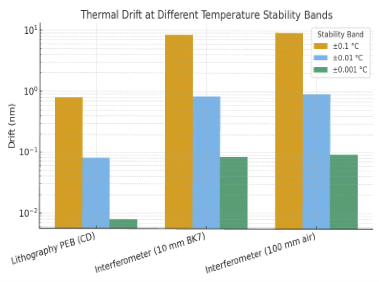
How far common elements move, or appear to move, for a given air temperature change. These are physical constants, not tool specifications.
| Element | Material | Length | Error at 0.1 °C | Error at 0.005 °C |
|---|---|---|---|---|
| Photomask blank | Fused silica (0.5 ppm/°C) | 152 mm | 7.6 nm | 0.4 nm |
| Wafer | Silicon (2.6 ppm/°C) | 300 mm | 78 nm | 3.9 nm |
| Interferometer beam path | Air (refractive index, ~0.93 ppm/°C) | 1 m | 93 nm | 4.7 nm |
| Stage or frame structure | Steel (11.5 ppm/°C) | 0.5 m | 575 nm | 29 nm |
Tool makers use low-expansion materials and software compensation to absorb part of this. Every nanometer the environment removes is one the tool does not have to correct.
One integrated environment
- Temperature. Critical point held to ±0.005 °C, with low-velocity, laminar air delivery that does not disturb the tool or the substrate.
- Humidity. Relative humidity held at setpoint to ±3% RH (±1% available), which also stabilizes the refractive index of air in interferometer paths.
- Cleanliness. HEPA or ULPA filtration with positive pressure, to ISO Class 5 or better inside the enclosure.
- Vibration and acoustics. Passive and active isolation and multi-layer acoustic construction, so the enclosure adds no disturbance of its own.
- Magnetic and RF shielding. Passive high-permeability shielding and active field cancellation for electron-beam tools; gasketed, non-ferrous RF shielding.
- Static control. One grounding scheme for the whole enclosure.
- Feedthroughs. Sealed, light-tight ports for cables, fiber, gas and vacuum lines.
These functions interact with each other and with thermal control. Shielding blocks airflow, acoustic panels hold heat, and isolation mounts change how the structure carries load. Praecis engineers them as one system.
Measured performance
In a 28-hour test, room temperature swung 1.19 °C while the critical point inside a Praecis Environment held within 0.005 °C, a ratio better than 200 to 1. Over a 10-hour quiet period it held within 0.002 °C.

Example installation. An ATCU-9 serves a 3 × 3 × 2.5 m enclosure inside an ISO Class 6 cleanroom, with a HEPA-filtered ceiling and PVC strip curtains at the entry.
How we work
- Engineering study. A fixed-fee design and estimating phase sets the specification, firm price and schedule for your tool and site.
- Design and build. Thermal, airflow, structural, shielding and acoustic performance are modeled together before fabrication.
- Install and tune. Praecis installs, commissions and tunes on site, and verifies performance at the critical point.
- Support. The ATCU logs conditions continuously, enabling remote monitoring.
Performance is guaranteed for complete Praecis Environments: designed, built, installed and tuned by Praecis. Praecis is AS9100 certified.
Talk to us
Tell us about your tool and process.