
Stable Conditions for Quantum Operation
Overview
Praecis designs, builds, and supports the environmental controls that quantum computing manufacturing and operation require. Custom environmentally controlled systems are Praecis’s core business. Each system, delivered as a Praecis Environment, is built around a Praecis Advanced Temperature Control Unit (ATCU),which holds thermal stability to ±0.005°C and controls and integrates every other environmental function.
The Requirements
In photonic quantum computing, photons carry the computation, routed through photonic chips in cryogenically cooled cabinets that are linked to form the full machine. The detectors run cold, but much of the system does not: lasers, room-temperature optics, fiber interconnects, control electronics, and the space around each cabinet. Outside the cryostat, thermal drift, vibration, acoustic noise, stray electric and magnetic fields, and contamination all erode photon fidelity and system performance, while the lasers themselves present hazards that must be contained.T hree further points shape how Praecis approaches this work:
(a) The cryogenic plant is itself a major source of vibration and acoustic noise, so isolation must be designed with the plant running.
(b) Cold interfaces create condensation risk, so humidity control must account for them specifically.
(c) The environmental disciplines conflict with one another. Every vent, door, window, and penetration is a potential leak path for heat, moisture, particles, sound, light, and RF, so the system must be engineered as one integrated whole.
Technical Capabilities
Temperature control. The Praecis ATCU is the core of every system. It holds thermal stability to ±0.005°C, delivers conditioned air through engineered paths that minimize gradients and turbulence, and coordinates the other environmental functions.
Humidity and cleanliness control. Relative humidity is held at a specified setpoint, typically 40–45% RH, within ±3% RH, with dew point kept below the coldest exposed surface to prevent condensation at cold interfaces. HEPA or ULPA filtration with positive internal pressure maintains ISO 14644-1 Class 5 or better inside the enclosure, and materials are selected for low outgassing and low particle shedding.
Acoustic and vibration isolation. Multi-layer acoustic construction blocks external noise, holding internal levels at NC-30 or below, and equipment mounting and airflow paths keep internally generated noise away from sensitive components. Passive and active vibration isolation is integrated where required to meet VC-E (3 μm/s) or better at the payload, including isolation from cryocooler-generated vibration.
Laser protection. Enclosures are configured as Class 1 laser enclosures where required, with light-tight construction, interlocked doors and access panels, and laser-safe viewing windows rated for the system’s wavelengths, supporting compliance with ANSI Z136 and IEC 60825.
RF, static, and magnetic shielding. A continuous, gasketed conductive shell blocks RF interference, with shielding effectiveness of 80 dB or greater from 10 kHz to 10 GHz, designed to IEEE 299. Grounded, static-dissipative construction (surface resistance 106–109 ohms, per ANSI/ESD S20.20) controls static electric fields. Static and low-frequency magnetic fields are held to below 100 nT residual variation with passive high-permeability shielding, active field cancellation, or both, designed together so they do not interfere.
Fiber and cable feedthroughs. Fiber, electrical, signal, and fluid lines enter through feedthrough panels configured to the system’s connection count. Waveguide ports and filtered connectors preserve RF shielding, and every penetration is sealed, light-tight, and acoustically treated so it maintains all other protections.
Integrated engineering. Praecis models and designs each Praecis Environment as one system, covering thermal and airflow, structural and vibration, shielding, and acoustics, and resolves the trade-offs between disciplines before fabrication. Final performance values for each project are set in the signed-off environmental specification.
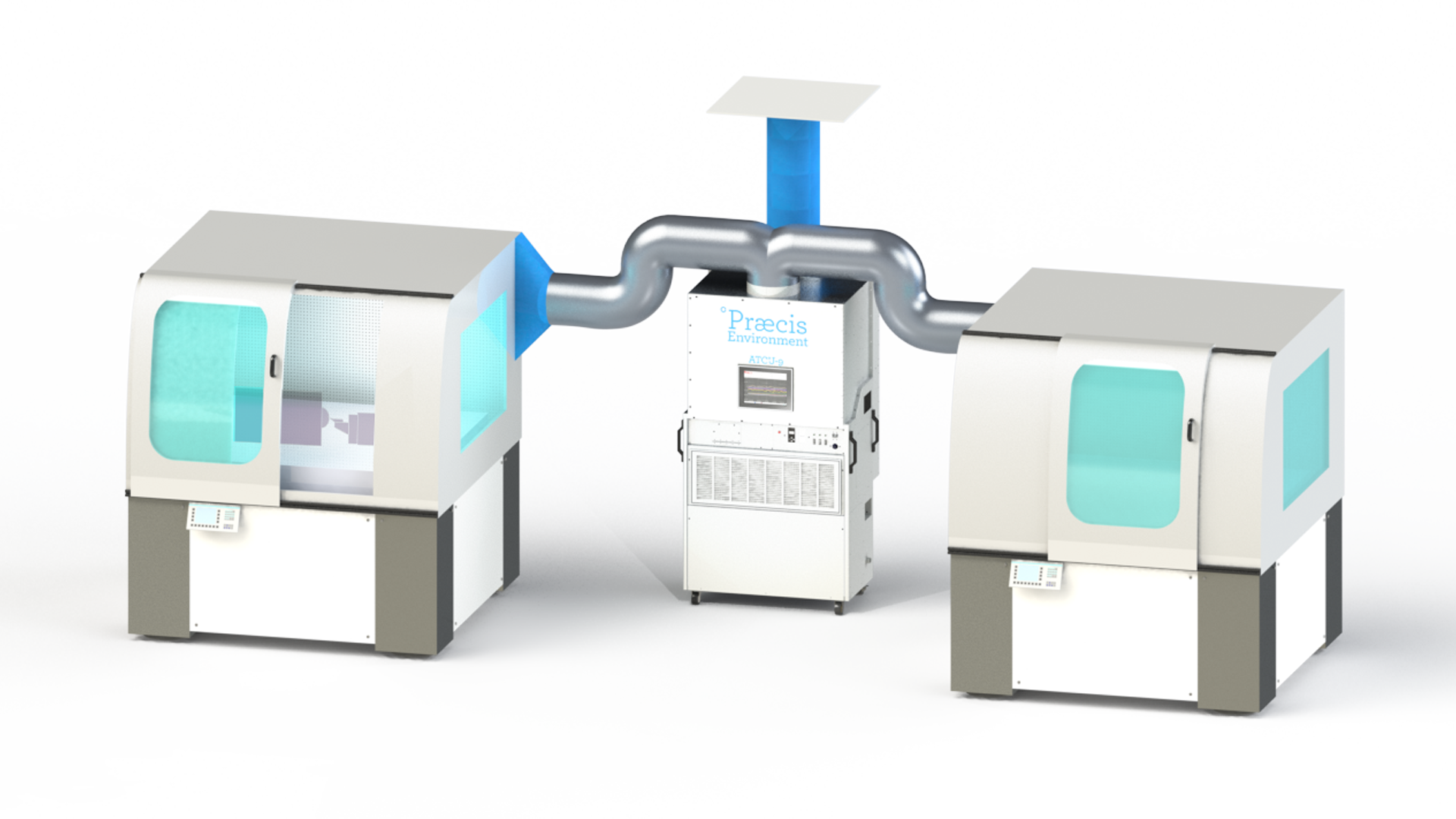
Dual Optics System

Small Optics Environment

Large Optics System